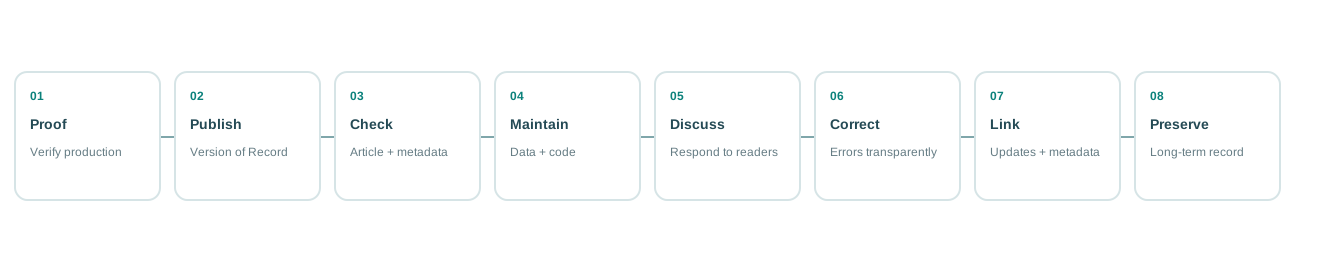
1. Publication Begins a New Phase of Author Responsibility
Publication does not end the author’s responsibility for the work. Once an article becomes part of the scholarly record, readers, clinicians, researchers, indexers and other systems may rely on it. Authors should therefore remain reachable, preserve relevant records and respond promptly when credible questions arise.
Post-publication responsibility includes distinguishing genuine errors from scientific disagreement, helping the journal investigate concerns, maintaining data and code access commitments, correcting metadata where appropriate and ensuring that public discussion does not misrepresent the published evidence.
The central principle is continuity: the people who took responsibility for the submitted work continue to share responsibility for the accuracy and integrity of the published record.
2. Proofs Are the Last Pre-Publication Quality-Control Stage
Proof review should focus on detecting production errors and confirming that the accepted work has been represented correctly. Check author names and affiliations, title, abstract, equations, symbols, tables, figures, legends, references, funding, competing interests, data statements and supplementary links.
Proofs are not normally an opportunity to introduce unreviewed analyses, new conclusions or major restructuring. If a substantive scientific change is genuinely necessary, tell the journal clearly so the editor can decide whether additional review is required.
All authors do not necessarily need to proofread every typographic detail, but the corresponding author should coordinate verification of high-risk elements and ensure that changes requested at proof stage are accurate.
3. Understand the Version of Record
The Version of Record is the formally published version that readers should cite and that publishing infrastructure identifies as the journal article. Authors should distinguish it from preprints, accepted manuscripts, proofs and personal copies.
Where a preprint exists, the published article and preprint should be linked appropriately rather than treated as interchangeable records. Crossref supports typed relationships between research objects, including relationships connecting preprints and later published versions.
Authors should cite and share the correct version in accordance with the journal’s policy, license and repository rules. When a published article is later corrected, readers should be directed to the current status and most recent valid version.
4. Verify the Published Article Immediately
Soon after publication, open the public landing page and full text rather than assuming production was flawless. Check DOI resolution, title, author names, affiliations, abstract, figures, supplementary files, license, references and important links.
Compare the public record against the approved proof. A missing supplement, corrupted figure or incorrect author metadata should be reported promptly because errors can propagate into indexing services and citation databases.
Do not attempt to fix an error by editing an external profile alone. Notify the journal so the authoritative publication and its metadata can be corrected at the source.
5. DOI and Metadata Are Part of the Scholarly Record
Persistent identifiers and metadata determine how published work is discovered, linked and attributed. Crossref states that DOI strings are persistent and cannot simply be changed or deleted after registration, while associated metadata can and should be updated when needed.
Authors should report errors in names, ORCID links, affiliations, title, funding, license or other metadata to the journal. The publisher is responsible for updating the authoritative deposit where appropriate.
Metadata maintenance is not cosmetic. Correct relationships between articles, corrections, retractions, preprints, datasets and other objects help readers and infrastructure understand the status and context of the work.
6. Honest Errors Should Be Reported Promptly
Finding an error after publication is not by itself evidence of misconduct. ICMJE explicitly recognizes honest errors as part of science and publishing and states that errors of fact that should have been recognized at publication may require correction.
Authors should assess what is wrong, where it occurs, what caused it and whether it changes data, analyses, interpretation or conclusions. Notify the journal with enough information to evaluate the effect rather than silently correcting copies hosted elsewhere.
Scientific debate, new evidence or evolving methods are not automatically errors in the original article. Those issues may be better handled through correspondence or new research.
7. Corrections Must Be Transparent and Linked
A meaningful correction should make the change visible to readers rather than silently replacing the published text. Current ICMJE guidance calls for a correction notice that identifies the changes and cites the original publication, along with clear version information and preservation of prior versions.
Authors should help the editor prepare an accurate explanation and verify the corrected material. The purpose is to restore accuracy while preserving the history of the record.
Crossref similarly recommends registering editorially significant updates and linking the update to the work it changes so that correction status can travel through scholarly metadata.
8. Minor Errors Versus Material Errors
Not every typographic imperfection requires a formal correction. The relevant question is whether the error affects meaning, attribution, interpretation, reproducibility or the integrity of the scholarly record.
A harmless spelling error in body text may not justify a formal notice, while an error in an author name, dosage, equation, data value, figure label or funding disclosure may have consequences beyond appearance.
Authors should not decide unilaterally that an error is too small to report when it could affect scientific interpretation or credit. Provide the facts to the journal and allow the editor to determine the appropriate publication response.
9. Pervasive Analytical or Coding Errors
An error in code, data transformation or statistical calculation can affect many locations at once. ICMJE notes that pervasive errors arising from coding or miscalculation may require an extensive correction when the direction and implications of the findings remain unchanged.
Authors should regenerate all affected analyses from a corrected workflow, identify every changed result and provide the editor with a transparent comparison. Do not repair only the values that readers have already noticed.
Preserve the erroneous and corrected code/data versions when possible so that the scope and origin of the problem can be reconstructed.
10. When Errors May Require Retraction or Retraction With Republication
If an error invalidates the results or conclusions, a simple correction may be insufficient. ICMJE states that serious errors can require retraction, while retraction with republication may be considered when an honest error causes a major change but the underlying science remains valid after further editorial scrutiny.
Authors should cooperate with the journal’s assessment rather than treating retraction as a punishment to be avoided at all costs. The objective is to ensure that readers can tell which findings remain reliable.
A retraction does not necessarily imply misconduct. Notices should explain the reason accurately enough to distinguish honest error, unreliable findings and misconduct-related concerns where the evidence supports those distinctions.
11. Expressions of Concern and Ongoing Investigations
When serious questions cannot be resolved quickly, a journal may use an interim notice such as an Expression of Concern while investigation continues. Authors should provide requested records promptly and avoid public claims that prejudge an unresolved process.
An interim notice protects readers without forcing the editor to reach a conclusion before sufficient evidence is available. It should not be treated by authors as equivalent to a final finding of misconduct.
If the investigation later resolves the concern, the scholarly record should be updated so readers can see the outcome.
12. Post-Publication Criticism and Scientific Debate
Published work may attract letters, commentaries, online discussion or replication attempts. Authors should distinguish criticism of interpretation from evidence of factual error.
Respond to substantive scientific questions with data, methods and reasoning rather than authority or tone. A critical comment does not automatically require a correction, and a correction should not be resisted merely because the underlying issue was first identified publicly.
Where the journal provides a formal correspondence mechanism, use it for durable scientific discussion that readers can connect to the article.
13. Data and Code Commitments Continue After Publication
A Data Availability Statement is a continuing representation, not a promise that expires at publication. If authors stated that data or code are available in a repository or through controlled access, the described route should remain functional for the stated retention period.
Maintain repository records, documentation, access instructions and persistent identifiers. If access conditions legitimately change, notify the journal when the published statement becomes materially inaccurate.
Do not delete code or data needed to support the publication merely because peer review has ended. Retention, privacy, consent, contractual restrictions and institutional policies continue to apply.
14. Correcting Data and Code Repositories
If a dataset or code package associated with the article is corrected, preserve version history where the repository supports it and explain what changed. Avoid replacing files silently when the change affects reproducibility.
Check whether the article’s Data Availability Statement, DOI relationships or supplementary links require updating. The scholarly record should allow a reader to determine which data/code version corresponds to which analysis.
For sensitive controlled-access data, update access documentation and governance records without exposing restricted information.
15. Supplementary Material Is Also Part of the Record
Errors in appendices, supplementary tables, protocols, checklists or multimedia files can affect interpretation even when the main article is correct. Authors should report material problems in supplementary content to the journal.
Do not maintain a corrected private supplement while the journal continues to serve an obsolete public file. The authoritative record should be updated through the journal’s process.
Where supplementary files have independent identifiers or repository versions, coordinate those records with the article-level correction.
16. Sharing the Published Work Responsibly
Authors may share their work through personal pages, institutional repositories, scholarly networks or other channels subject to the article’s license and journal policy. Distinguish the Version of Record from accepted manuscripts and preprints when sharing.
Do not remove copyright, license or correction information from copies. If the article has been corrected or retracted, avoid continuing to circulate an obsolete version without a clear status notice.
Open access does not mean the work has no conditions of reuse. Follow the specific license attached to the article.
17. Preprints After Journal Publication
When a preprint preceded the journal article, update the preprint record where the platform permits so readers can find the Version of Record. Crossref supports relationship metadata linking posted content to the later published object.
Do not rewrite the preprint in a way that obscures the chronology of versions. Readers should be able to distinguish the earlier public manuscript from the peer-reviewed publication.
If the journal article is later corrected or retracted, consider whether the preprint record should also point readers to the updated publication status.
18. Citations, Profiles and Researcher Identifiers
Check that the publication appears correctly in relevant author profiles and institutional systems, but treat the journal’s record as authoritative. ORCID and other identifiers help connect authors to outputs but do not replace publisher metadata.
If citation databases contain an error that originates in the journal metadata, correct the source record first. External databases may then ingest the update on their own schedules.
Do not manipulate citation metrics through coordinated self-citation, citation exchanges or misleading promotion. Post-publication visibility should not compromise scholarly integrity.
19. Communicating Findings to the Public
When discussing a published study with media, institutions, professional networks or social media, represent the design, uncertainty and limitations accurately. Do not turn an association into causation or a preliminary result into established clinical guidance.
Use the published article as the reference point and disclose relevant corrections or changes in status. Promotional summaries should not make claims stronger than those supported by the Version of Record.
If a public post contains a substantive misstatement, correct the post rather than relying on readers to discover the discrepancy in the article.
20. Post-Publication AI Use
AI may be used to help summarize or communicate a published article, but authors remain responsible for accuracy. Generated summaries can distort effect sizes, omit limitations or invent implications not present in the paper.
Do not upload restricted underlying data, confidential investigation material or unpublished correspondence into external AI systems without appropriate authorization. Publication of the article does not automatically make all supporting materials public.
If AI is used to generate translations, summaries, graphical material or derivative communication, verify the output against the Version of Record and comply with applicable rights and disclosure requirements.
21. Requests for Data, Materials and Clarification
Respond to legitimate scholarly requests in a timely and professional way, subject to privacy, consent, legal, contractual and resource constraints. If a controlled-access process was promised, use that process consistently.
Authors are not required to disclose protected information merely because a requester asks for it. Explain legitimate restrictions and, where possible, provide an authorized path to access or a less sensitive alternative.
Keep records of consequential data-sharing decisions, particularly when requests involve participant-level or commercially restricted data.
22. Authorship and Contribution Issues Discovered After Publication
If an authorship omission, inappropriate inclusion, order dispute or inaccurate contribution statement emerges after publication, notify the journal. Do not attempt to solve the published record only by changing personal profiles.
Post-publication authorship changes may require agreement, documentation and editorial assessment. When agreement cannot be reached, institutions may need to resolve factual disputes about contributions.
A correction to authorship should preserve transparency about the change and should not be used to conceal a deeper integrity concern.
23. Competing Interests and Funding Corrections
If a relevant competing interest, funding source or sponsor role was omitted or inaccurately reported, notify the journal promptly. The significance depends on the nature of the omission and its potential relevance to readers.
Correcting a disclosure does not automatically invalidate the research, but leaving a known material omission uncorrected undermines transparency.
Ensure that related public statements, repository records or author disclosures do not continue to repeat the incorrect information after the journal updates the record.
24. Complaints, Allegations and Institutional Investigations
When a post-publication concern involves possible misconduct, journals and institutions may have different responsibilities. Authors should preserve records, respond factually and avoid destroying or altering material relevant to the inquiry.
Do not pressure complainants, reviewers, editors or institutions to withdraw legitimate concerns. Equally, authors may provide evidence and procedural information relevant to a fair assessment.
The journal’s role is to protect the scholarly record; an institution may be better positioned to investigate conduct, employment records or primary research documentation.
25. Preservation and Long-Term Accessibility
Electronic publication requires durable access. ICMJE notes that electronic publishing creates specific issues around link stability and content preservation, while preservation systems such as LOCKSS are designed to maintain published electronic materials over time.
Authors should use persistent links and identifiers rather than temporary file-sharing URLs when referring readers to research objects. Where repositories are used, select services with credible preservation and stewardship practices.
Long-term preservation is principally a publisher and repository responsibility, but authors contribute by depositing durable research objects and avoiding fragile personal-hosting arrangements for essential materials.
26. Metadata Updates Should Follow Content Updates
When a correction, retraction or other significant update occurs, associated metadata should reflect it. Crossref supports update relationships so that infrastructure can connect a notice to the article it changes.
Crossref also encourages long-term maintenance of DOI metadata, including resolution URLs and update status. This means publication maintenance continues after the initial DOI registration.
Authors do not normally make publisher DOI deposits themselves, but they should alert the journal when metadata no longer represents the published record accurately.
27. Preserve Your Own Author Record
Keep the accepted manuscript, Version of Record, proof correspondence, relevant datasets and code, permissions, ethics documentation and important post-publication correspondence according to applicable retention requirements.
A coherent author archive helps resolve later questions about what was approved, what was published and when a problem was identified. It is especially important when projects span institutions or when corresponding authors change positions.
Storage should remain secure and proportionate to sensitivity; preservation does not justify retaining identifiable data longer than ethics, consent or law permits.
28. Treata After-Publication Standard
Treata treats publication as stewardship of a continuing scholarly record. Authors should verify the published work, maintain promised research resources, report material errors promptly, cooperate with correction or integrity processes and communicate the work without overstating its evidence.
Material post-publication changes should be transparent, linked and preserved rather than silently overwritten. The status of corrections, Expressions of Concern and retractions should be visible to readers and connected through appropriate metadata.
Journal-specific procedures determine how authors submit correction requests, correspondence or post-publication materials. Those procedures operate alongside Treata’s canonical standards for Corrections, Retractions & Expressions of Concern, Research Data, Archiving & Preservation, Policy Versioning and Publication Ethics.
Connected author manuals
Related author guidance
Canonical Treata standards